By Digital Factory, we mean an integrated environment where design, simulation, and operational management converge.
Unlike the Smart Factory, which focuses on automation and interconnectivity, the Digital Factory is an approach that also includes the decision-making and predictive dimension.
AI and industrial simulation: from analysis to decision with intelligent Digital Twin
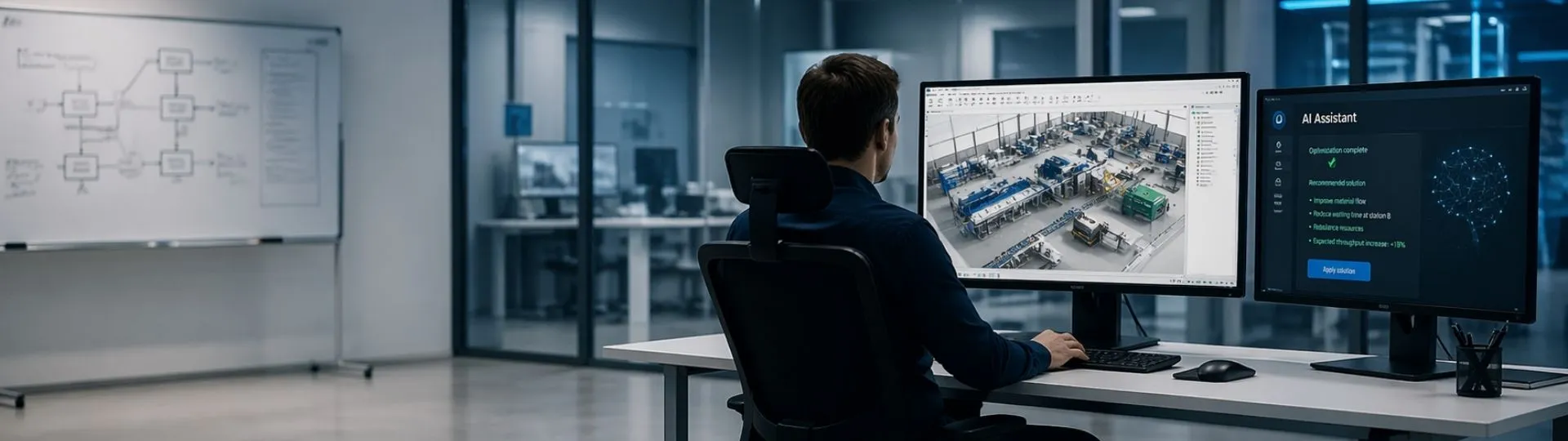
With the maturity level reached by artificial intelligence, the role of industrial simulation is set to evolve rapidly: from analysis tool to active component of decision intelligence systems.
Simulation will no longer be limited to representing the system, but will increasingly influence operational decisions, eventually proposing the most effective choices in an automated way.
Those who design, optimize, and manage complex systems are increasingly asking the same question—somewhere between curiosity and concrete expectation:
Can artificial intelligence reduce—or partially replace—the decision-making process behind operational choices?
Simulation and AI: from validating models to generating decisions
In a traditional approach, simulation is used to represent a system, analyze alternative scenarios, and provide useful data for informed decisions.
With the evolution of Digital Twin, models have already integrated the ability to remain aligned with real systems over time, also through continuous updates from operational data. Today, the distinctive contribution of artificial intelligence lies in using simulation not only to analyze a system, but as an environment in which to train and validate AI systems—for example through reinforcement learning techniques—already integrated into some simulation platforms, capable of learning decision-making strategies through interaction with the model.
In this context, early signs of a broader transformation are emerging: the relationship between simulation and AI is evolving from a model in which simulation supports AI, to one in which AI actively contributes to structuring, guiding, and orienting both the simulation and decision-making processes.
| Aspect | Traditional simulation | Simulation → ai | Ai → simulation |
|---|---|---|---|
| Role of simulation | Scenario analysis | Training environment | Guided and adaptive system |
| Role of ai | Absent | Learning from simulation | Decision generation and selection |
| Output | Evaluation of alternatives | Learned strategies | Suggested/prioritized actions |
| Decision process | Human-driven | Supported by ai models | Progressively structured by ai |
In this context, simulation enters operational processes and becomes an active component in building and managing decision-making within the Smart Factory.
AI and discrete event simulation (DES): operational implications
Signals of further evolution are emerging. In high-variability contexts such as manufacturing, logistics, or automation, the limitation is no longer the ability to generate or analyze scenarios, but the management of decision complexity.
The role of simulation is shifting: not only an environment in which AI learns, but a structure through which the decision-making process is progressively organized, filtered, and made more direct.
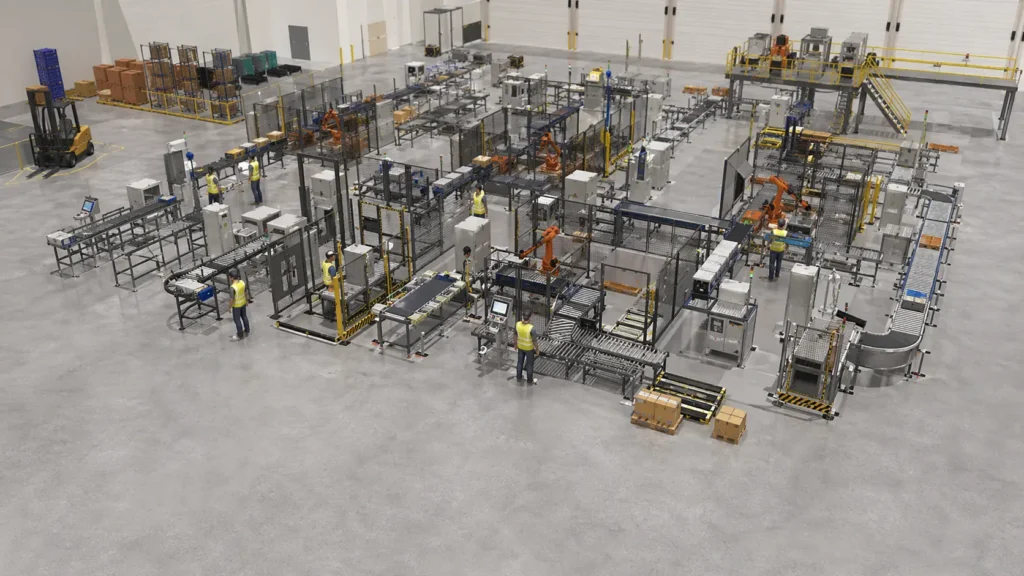
Towards models that guide the process
It is reasonable to expect that the integration of simulation and artificial intelligence will evolve toward models capable of:
- Reducing the space of alternatives
- Highlighting the most relevant operational configurations
- Making explicit the relationships between decisions and results
Simulation would no longer be used exclusively as an analysis tool, but as a structure capable of organizing and guiding decisions, making the process more explicit, consistent, and manageable—especially in complex environments.
Evolution of simulation–AI
| Dimension | Current approach | Expected evolution |
|---|---|---|
| Role of simulation | Analysis and training environment | Active decision structure |
| Role of ai | Learning from simulation | Guidance of decisions |
| Output | Strategies and insights | Suggested and prioritized actions |
This approach enables the management of complex systems with greater awareness, reducing uncertainty and making the decision-making process more structured even in the presence of high operational variability.
Smart Digital Twin
An AI-integrated Digital Twin represents an evolution of the simulation model: not only a replica of the real system, but a dynamic environment capable of observing, interpreting, and interacting with the operational context.
In this perspective, the model tends to become a living simulation, connected to real data and control systems (also in a Virtual Commissioning perspective), capable of supporting the entire lifecycle of the plant—from design to operational management.
The integration of decision-making capabilities introduces an additional layer: the digital twin does not only represent the system, but contributes to making decisions explicit and to interacting with those who make them, while keeping the engineer and decision-maker central.
For these capabilities to be truly effective and scalable, the model must necessarily be part of a broader context in which people, systems, and data are coordinated across the entire lifecycle of the plant (Digital Factory).
Digital Factory Explained
Operational impacts
In this direction, the integration between simulation and Artificial Intelligence can contribute to reducing the time between observation and action, making the decision-making process faster and more structured, with a direct impact on simulation ROI.
In particular, this translates into the ability to:
- Access more granular and readable information directly from the model
- Identify non-obvious critical issues
- Anticipate problematic operational conditions
- Rapidly explore improvement hypotheses
Application areas
| Area | Traditional simulation | Simulation + ai |
|---|---|---|
| Manufacturing efficiency | Initial resource optimization | Prioritization of operational actions |
| Costs | Reduction of inefficiencies in the design phase | Reduction of decision uncertainty |
| Layout | Configuration validation | Guided selection of the most effective configurations |
| Energy | Consumption analysis | Decision support for energy optimization |
Towards Decision Intelligence
Decision Intelligence represents an approach oriented toward the engineering of the decision-making process, in which data, models, and algorithms contribute to making decisions more informed, contextualized, and verifiable.
Within this paradigm, the dialogue between AI and simulation introduces a substantial shift in the role of the model. Simulation no longer simply describes or analyzes the system, but actively participates in managing decisions.
So-called “cognitive” models emerge, capable of linking data, decision logics, and system behavior, making the operational implications of decisions explicit.
It is in this transition that simulation becomes part of a broader technological framework, traceable to Decision Intelligence initiatives within the company, where the decision-making process is progressively structured, made traceable, and engineered.
FAQ
How does simulation evolve with artificial intelligence?
Artificial intelligence transforms simulation from an analysis tool into a decision-support system. It enables the structuring and support of operational choices, improving the speed, quality, and consistency of decisions in complex environments.
Can AI replace the process engineer?
No, artificial intelligence does not replace the engineer. It automates certain analytical tasks and suggests alternatives, but the decision-maker retains responsibility, supervision, and validation of choices.
What is Decision Intelligence?
Decision Intelligence is an approach that integrates data, models, and algorithms to improve the decision-making process. It enables more informed, contextualized, and verifiable decisions, especially in complex environments.
When do AI and simulation generate the most value?
AI and simulation generate the most value in complex and variable contexts, such as supply chain, logistics, and manufacturing. In these areas, they enable faster decisions and the management of multiple constraints and alternative scenarios.
Recommended insights
Contact Flexcon to find the simulation solution that best fits your processes.