Digital Twin and Digital Factory Compared: Definitions and Applications in Production Systems
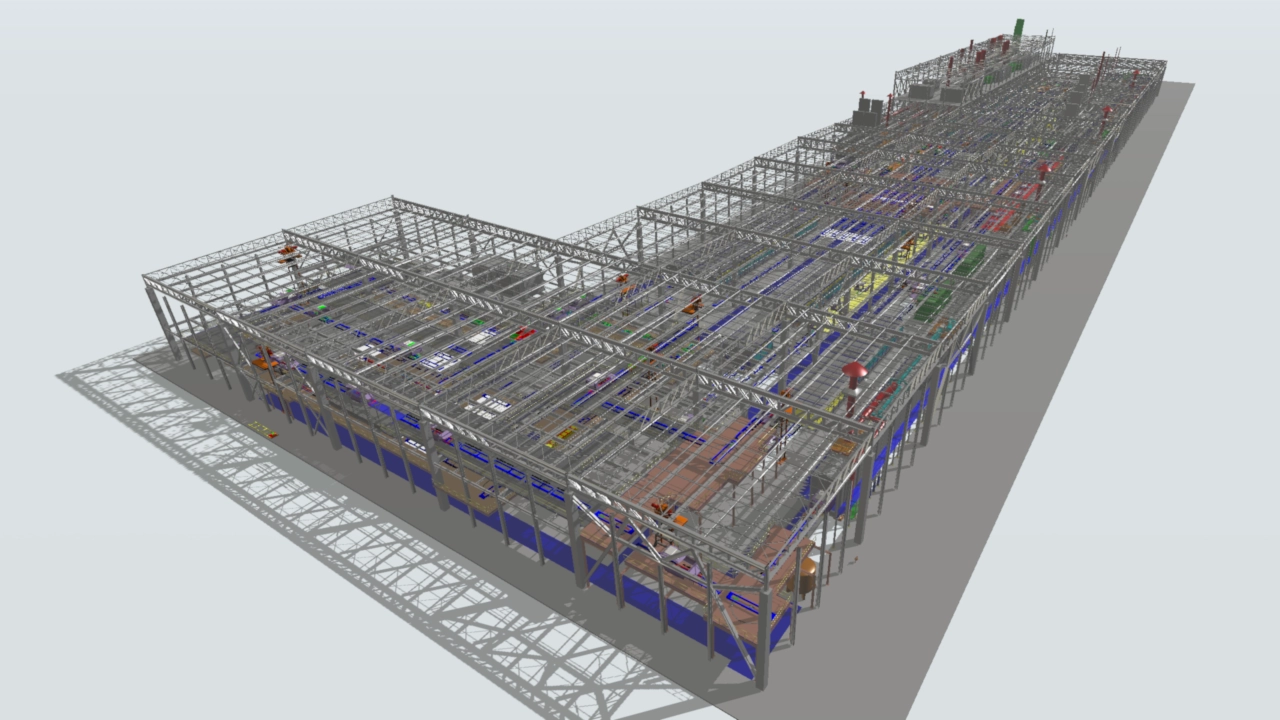
In the evolution toward Industry 4.0 and Industry 5.0 models, the terms digital twin and digital factory are often used interchangeably, without a clear conceptual distinction.
In reality, they represent different levels of digital design and respond to very different operational objectives. Understanding this distinction is essential for defining a coherent roadmap for the digital transformation of production systems.
What is the difference between digital twin and digital factory?
The difference between digital twin and digital factory concerns the level of application and the functional objective.
A digital twin is a dynamic digital model of a specific asset or process, aimed at predictive simulation and optimization.
A digital factory, on the other hand, represents an integrated architecture that coordinates people, systems and data throughout the entire lifecycle of the production plant.
Digital twin: dynamic model and predictive simulation
A digital twin is a dynamic digital replica of an asset, a production line, or a manufacturing process that:
- exchanges data bidirectionally with the physical system
- reproduces behaviour, constraints and operational logic
- enables predictive simulations and “what-if” scenarios
- supports virtual commissioning and continuous optimization
Among the elements that characterize a digital twin from a technical perspective, process simulation can play a central role.
A digital twin is not simply a copy of the real system, but a dynamic and computational representation of its operational behaviour, capable of modelling dynamics, flows and interactions.
When this simulation component is absent, the system more properly falls within the domain of advanced monitoring or digital shadow.
If the representation is limited to geometric modelling or a 3D CAD layout of the physical system, without operational dynamics or data integration, it is more accurate to refer to it as a digital model.
The distinction between digital model, digital shadow and digital twin reflects different levels of maturity and functional capability within digital systems (see also → differences between digital model, digital shadow and digital twin).
Digital factory: integrated ecosystem and lifecycle management
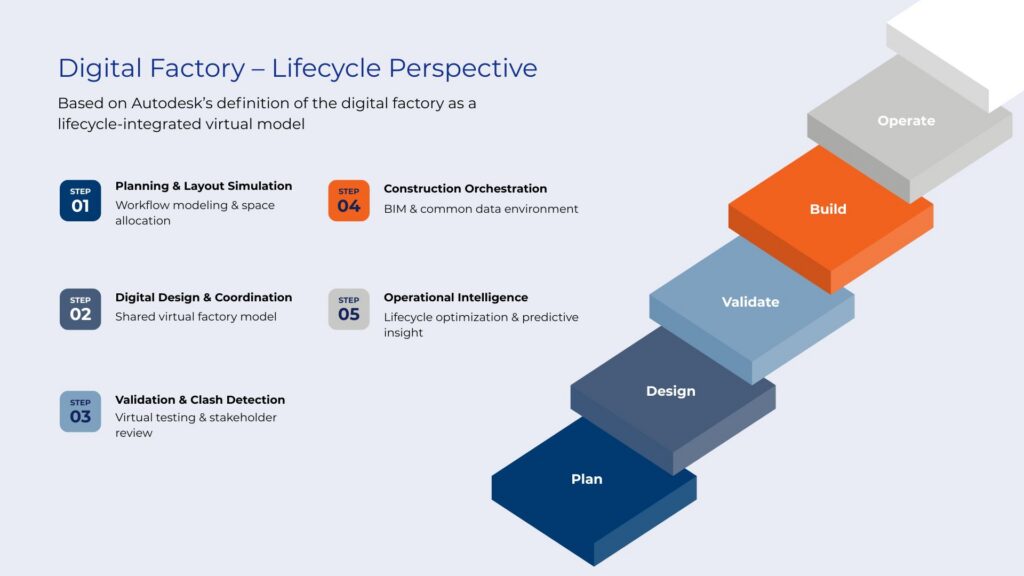
If the digital twin is a modelling and simulation tool, the digital factory represents a systemic concept.
From a technical perspective, it can be interpreted as the digital architecture of the factory, integrating design, simulation, operational data and lifecycle management of the production system.
In some authoritative interpretations, the digital factory is described as a shared digital model of the entire factory, capable of integrating data related to structure, assets, processes and performance throughout the lifecycle of the plant.
In this lifecycle-oriented perspective, the digital factory architecture develops across the phases of planning, design, construction and operation (Plan, Design, Build, Operate), a framework also adopted in recent industrial initiatives dedicated to the digital transformation of manufacturing.
The digital factory therefore does not correspond to a single technology, but to an integrated architecture in which:
- machines, people and information systems are interconnected
- data are collected, orchestrated and distributed throughout the production flow
- planning, execution and control operate in digital continuity
- plant design and management rely on a shared data environment
This architecture may include:
- ERP and MES systems
- industrial automation
- IIoT connectivity
- structured production data management
- simulation tools and digital twins
In summary:
The digital twin is an advanced model.
The digital factory is an integrated organizational and technological strategy.
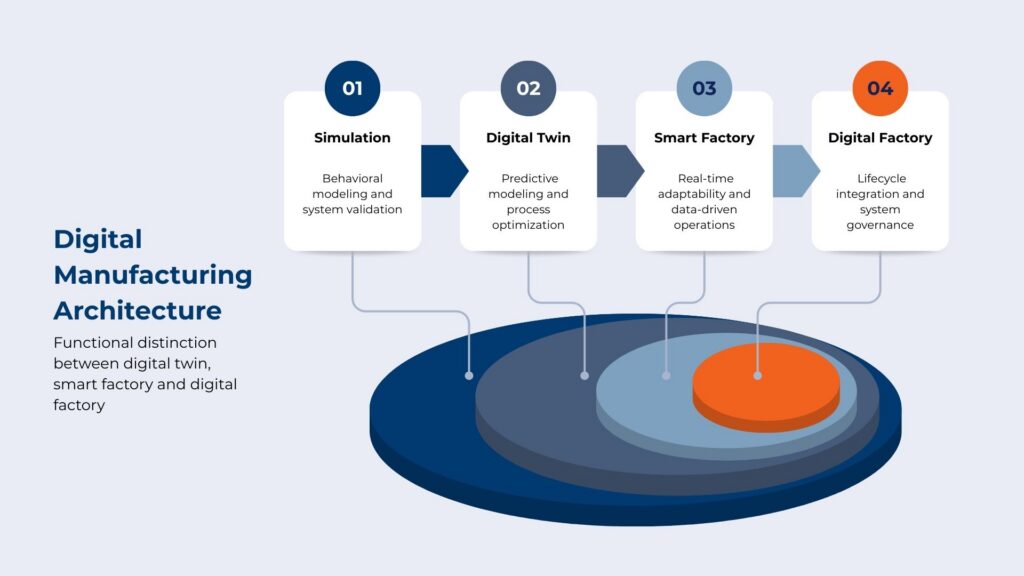
Smart factory: cyber-physical system and operational adaptability
The term smart factory emerged in the early 2010s with the rise of the Industry 4.0 paradigm, to describe a cyber-physical production system characterized by:
- extensive interconnection between machines, sensors and information systems
- real-time data exchange
- vertical and horizontal integration of information flows
- adaptive capabilities based on analytics and advanced algorithms
From a functional perspective, the smart factory prioritizes real-time operational optimization: it monitors the current state of the production system and adjusts operating parameters based on the available data.
It does not necessarily imply a structured predictive simulation component. When present, this capability is typically implemented through a digital twin, which can be integrated into the overall architecture to extend analysis from managing the present state to evaluating future scenarios.
In this interpretation, the smart factory represents the adaptive operational layer of the digitalized production system.
(Example sources: Hermann, Pentek, Otto, 2016; NIST – Smart Manufacturing definitions)
It is therefore useful to distinguish the three concepts on a functional and structural basis, highlighting their different areas of application and objectives.
Summary framework – conceptual level
| Concept | Main Function | Focus | Objective |
|---|---|---|---|
| Digital Twin | Predictive modelling and simulation | Specific asset, production line or process | Validate future scenarios and optimize before real execution |
| Smart Factory | Real-time operational adaptability | Interconnected production system | Optimize current operations based on available data |
| Digital Factory | Lifecycle integration and governance | Overall architecture (Plan–Design–Build–Operate) | Orchestrate operational and modelling components coherently |
Strategic implications for manufacturing companies
A conceptual overlap between digital twin and digital factory can affect design and investment decisions. For example:
- considering a 3D CAD layout model, even if animated, as a digital twin in the absence of process simulation
- investing in interconnected digital infrastructures without including tools for modelling and preventive validation
- developing advanced simulation models only during the design phase, without connecting them to real data and operational systems, making continuous improvement and progressive integration across the factory lifecycle less effective
An example of an evolutionary roadmap
A coherent transformation can follow a structured path:
| Step | Objective | Enabling Tool | Result |
|---|---|---|---|
| 1 | Model the system | 3D simulation | Validation of layout and flows |
| 2 | Test control logic | Virtual commissioning | Reduced start-up risks |
| 3 | Integrate real data | IIoT connectivity | Transition toward digital twin |
| 4 | Continuous improvement | Predictive simulation | KPI improvement |
| 5 | Integrate into the enterprise system | Digital factory architecture | Full governance |
The role of simulation
Within the evolutionary path described above, industrial simulation of production processes represents the first structured level of digital maturity: it is the starting point that allows the production system to be modeled even before it is interconnected or made operationally adaptive.
Through simulation, it becomes possible to validate configurations, test alternative scenarios and verify operational logic without impacting the real system. It is in this phase that the foundations are built for a truly predictive digital twin and for its coherent integration within the architecture of the digital factory.
FAQ
Frequently asked questions about digital twin and digital factory
Is the digital twin part of the digital factory?
In many advanced architectures, the digital twin represents a modelling component that can be integrated within the digital factory. However, it remains distinct in scale, scope and operational purpose.
What is the difference between smart factory and digital factory?
A smart factory describes an interconnected production system capable of adapting operations based on data collected in real time. A digital factory, on the other hand, represents a broader architectural model that integrates design, data, systems and processes throughout the entire lifecycle of the plant.
Does a digital factory necessarily require a digital twin?
A digital factory can be implemented as an integrated architecture of data, systems and processes even without a structured predictive modelling component. However, integrating a digital twin extends its capabilities toward preventive validation and the analysis of future scenarios.
Contact Flexcon to discuss how simulation and digital twin technologies can help design, validate and optimize your production systems.