Digital twin vs digital shadow vs digital model: key differences explained
Digital Twin, Digital Shadow and Digital Model are often mentioned together, but they describe different levels of connection between a physical system and its digital representation. In industrial automation and production system simulation, understanding these differences helps companies choose the right approach for design validation, monitoring and optimization.
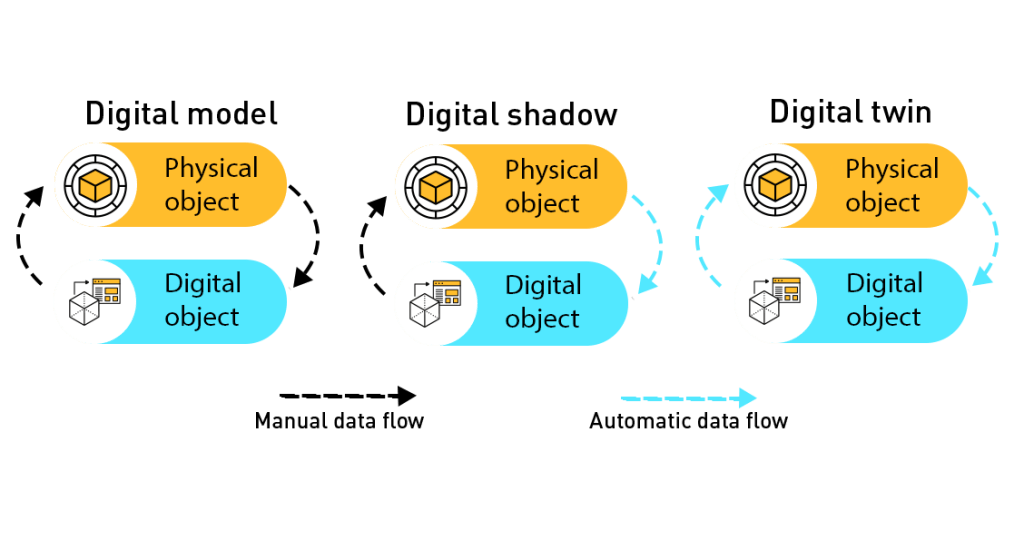
What is a Digital Model? A digital model is a static or manually updated representation of a system, not connected to real-time data.
What is a Digital Shadow? A digital shadow receives real-time data from the physical system in a one-way flow (from physical to digital).
What is a Digital Twin? A digital twin enables bidirectional real-time data exchange between physical and digital systems, supporting simulation, prediction and optimization.
In production system simulation, understanding these differences is essential to optimize processes, reduce downtime and enable smart factory strategies.
In production system simulation, these three concepts are not alternatives in the abstract: they usually represent different stages of maturity. Starting from 3D simulation, companies can validate layouts and flows, then progressively integrate real data and control logic to move from a digital model to a digital shadow, and finally to a digital twin. This evolution supports better decisions, lower downtime and more scalable smart factory strategies.
Digital Twin vs Digital Shadow vs Digital Model: a technical comparison
The core difference lies in the way each technology interacts with real-world data and with the physical system itself.
- Digital Model → no real-time data connection
- Digital Shadow → one-way data flow from physical to digital
- Digital Twin → bidirectional data exchange between physical and digital systems
In practice, a digital model is mainly used to represent and validate a system, a digital shadow adds real-time visibility, and a digital twin adds the ability to simulate, predict and influence operations. On a broader scale, approaches such as the digital factory extend this concept to the entire production system. (further reading:comparison between digital twin, digital factory and smart factory).
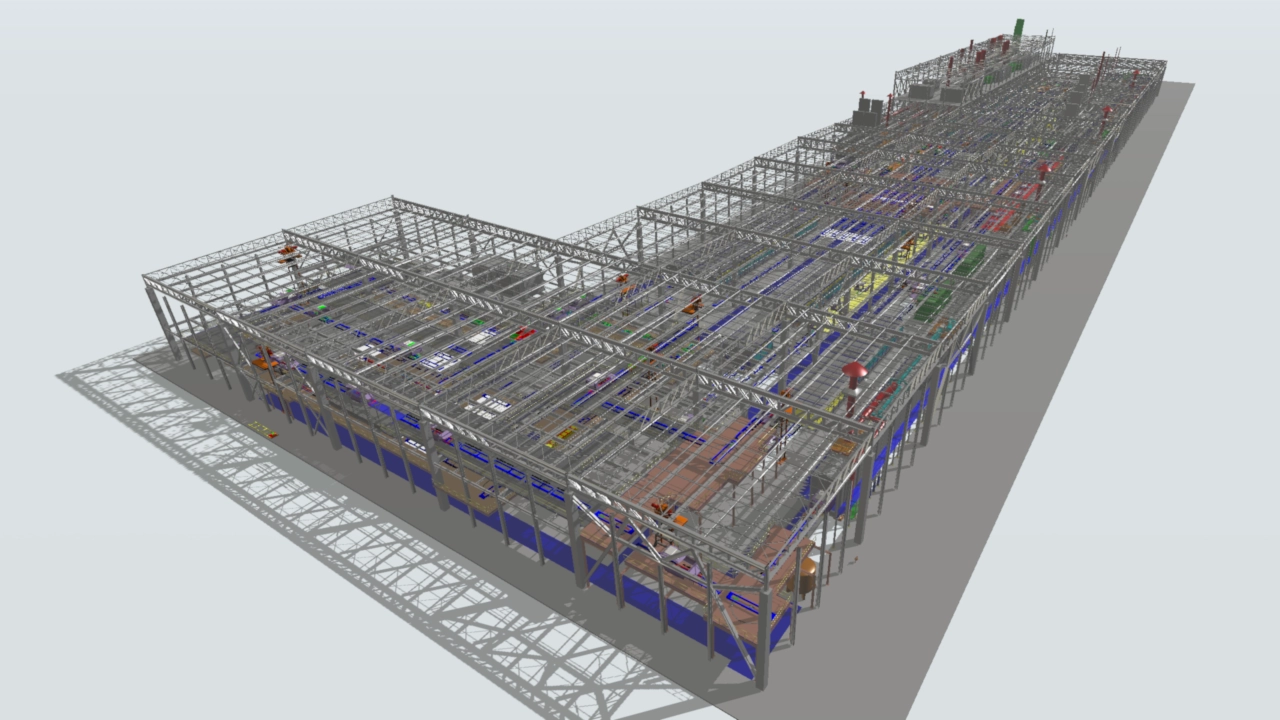
Digital Model
📖 Definition
A digital model is a 3D representation of a product, plant or production layout. It can be static or dynamic, but it is not connected to real-time production data.
Applications
• Design and configuration of systems
• Layout planning
• Basic simulation of production and logistics processes
Example
An automotive company creates a 3D model of an assembly line to test robot movements. However, the model remains isolated and does not reflect actual production conditions.
Digital Shadow
📖 Definition
A digital shadow is a virtual model that receives real-time data from its physical counterpart. This connection is one-way: it reflects the system state but cannot control or optimize it.
Applications
• Monitoring of machine performance
• Data collection for production analysis
• Predictive maintenance based on real data
Example
A logistics company uses a digital shadow to track conveyor belt speed and identify inefficiencies. Any adjustments are made outside the model.
Digital Twin
📖 Definition
A digital twin is a real-time digital replica of a physical system that continuously exchanges data with its real counterpart. This bidirectional connection enables monitoring, simulation of operational scenarios and continuous optimization of production processes.
Unlike a digital shadow, it not only receives data but can also influence the physical system through advanced simulations, predictive analytics and automation.
Applications
- Virtual commissioning to test automation before and after implementation
- Real-time optimization of production processes
- Advanced predictive maintenance with artificial intelligence
- Training of operators in simulated environments
Example
A pharmaceutical company uses a digital twin of its production line to adapt machine performance based on demand, improving efficiency and reducing downtime.
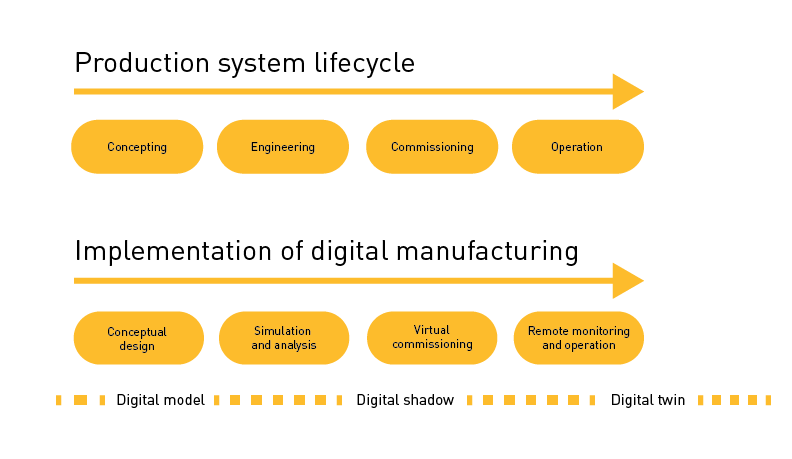
Key differences at a glance
A quick comparison of data connection, capabilities and use cases.
| Feature | Digital Model | Digital Shadow | Digital Twin |
|---|---|---|---|
| Data connection | ❌ None | ☑️ One-way | ☑️ Two-way |
| Real-time updates | ❌ No | ☑️ Yes | ☑️ Yes |
| Can influence physical system? | ❌ No | ❌ No | ☑️ Yes |
| Use cases | Conceptual design | Monitoring & reporting | Optimization & automation |
ROI of Digital Twin implementation
The adoption of a digital twin enables measurable improvements in efficiency and cost reduction. By combining advanced simulation, real-time data and predictive analytics, companies can improve productivity and process resilience.
In many industrial contexts, operating costs can be reduced by up to 20–30%.
A simplified way to express the value of simulation is:
ROI = (avoided costs + operational efficiency gains) / simulation investment
This approach helps quantify the value generated not only in economic terms, but also in reducing decision-making risk.
Improvement of the decision-making process: early validation of design choices
Downtime reduction: simulation and predictive maintenance
Optimization of production flows: design and pre-implementation validation
Virtual Commissioning: reduction of errors and commissioning time
CAPEX reduction: fewer physical modifications and non-optimal investments
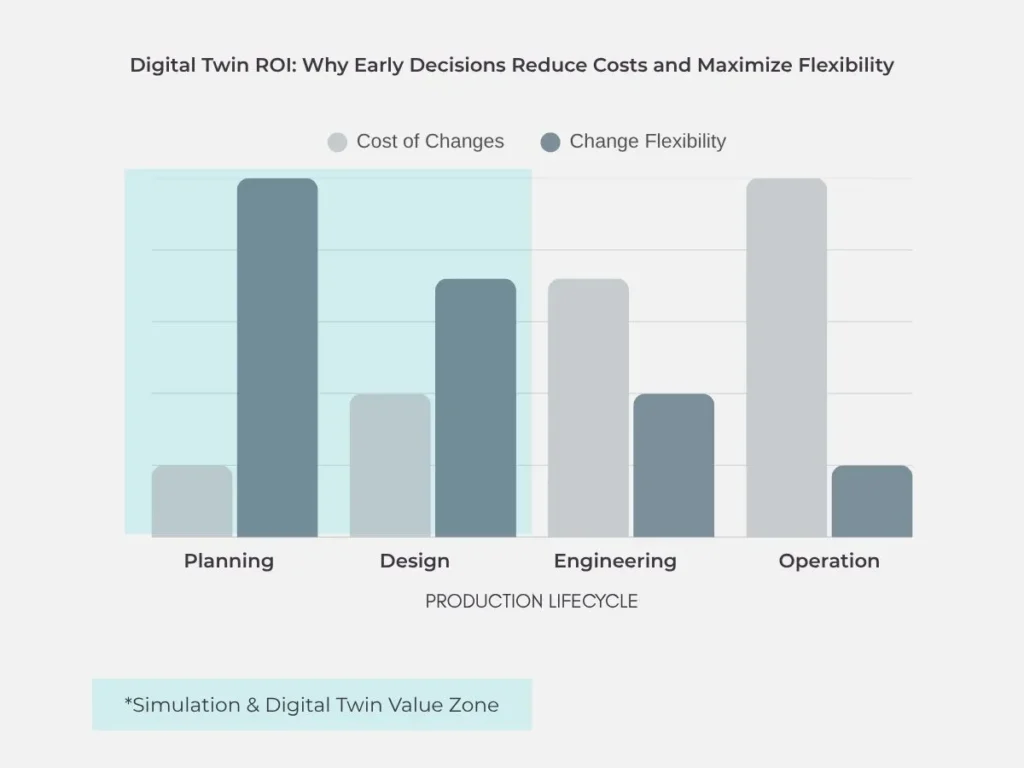
Scalability of Digital Twin: from model to operational replica
The adoption of a digital twin follows a structured path:
| Phase | Tools / Software | Key skills | Operational objective |
|---|---|---|---|
| Simulation and validation | 3D simulation software and Discrete Event Simulation (e.g. FlexSim for DES, Visual Components for layout and robotics) | Process modeling, flow analysis, production layout | Validate scenarios and optimize the system before implementation |
| Virtual Commissioning | Virtual Commissioning platforms, PLC integration | Industrial automation, control logics, system integration | Test and optimize systems before commissioning |
| Data integration (IIoT) | Industrial IoT, MES/SCADA systems | Data integration, digital architectures | Enable the transition from Digital Shadow to Digital Twin |
| Advanced optimization | Analytics, AI, predictive models | Data analysis, machine learning, continuous improvement | Reduce downtime and improve operational performance |
Simulation is the foundation that enables continuous alignment between physical systems and digital models across the entire lifecycle.
FAQ
What makes a Digital Twin different from a Digital Shadow?
The key difference is bidirectional data exchange. A Digital Shadow receives real-time data from the physical system, while a Digital Twin both receives data and can influence the physical system through simulation, predictive logic and optimization.
Why start from 3D simulation?
3D simulation is the foundation for validating layouts, flows, resources and automation logic before implementation. It is often the first step in moving from a digital model toward more connected and operationally advanced systems.
When is a Digital Model enough?
A Digital Model is enough when the goal is to design, configure or validate a system without using real-time production data. It is especially useful in conceptual design, layout planning and early-stage simulation activities.
What is Virtual Commissioning and why is it important?
Virtual Commissioning makes it possible to test and optimize automation systems before physical commissioning. It helps reduce integration errors, startup time and commissioning costs, while improving confidence in system performance.
Contact Flexcon to develop a tailored simulation and Digital Twin project.
Last updated: April 22, 2026