An introduction to the Model Context Protocol (MCP) and its role in enabling interoperability between AI models, data sources, and software systems.
(International Journal For Multidisciplinary Research)
LLMs, AI Agents, RAG, and MCP: AI, Interoperability, and Industrial Simulation
Which AI applications have already reached maturity in industry, and which new scenarios are emerging for simulation and Digital Twins?
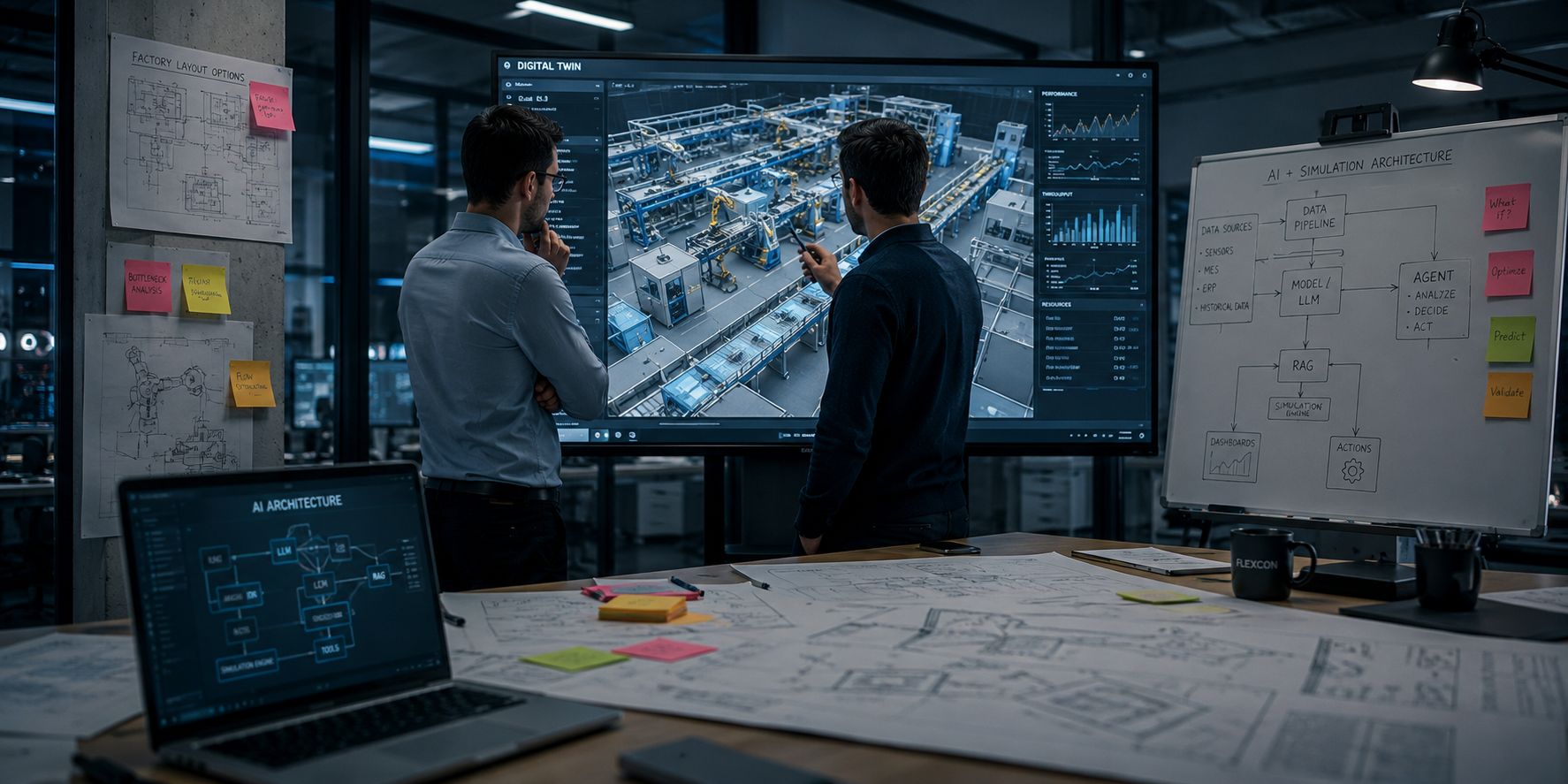
Following an initial phase dominated by Large Language Models (LLMs) and conversational interfaces, we are now witnessing a race to integrate AI with operational data, software systems, simulation environments, and decision-making processes.
This evolution is impacting the entire manufacturing sector, from production and logistics to supply chain management and intralogistics. Across these domains, companies, software vendors, and research centres are experimenting with new approaches to integrate AI into operational processes and decision-support tools, fostering a progressive democratization of access to data, models, and specialized expertise.
For organizations that rely on industrial simulation to design, analyse, and optimize production and logistics systems, the key question becomes which AI technologies and layers can support activities such as model analysis, process optimization, the understanding of complex systems, and the evaluation of alternative scenarios.
Understanding the differences between LLMs, AI Agents, RAG, and MCP is the first step towards applying Artificial Intelligence to process engineering. Technologies that are enabling new forms of interaction between AI, simulation models, data, and enterprise systems. These differences also help explain why simulators, Digital Twins, and DES models are becoming some of the most promising environments for experimenting with emerging AI architectures.
AI approaches, models, and architectures
Terms such as Machine Learning, Deep Learning, LLMs, RAG, AI Agents, and MCP refer to technologies that operate at different layers of the Artificial Intelligence stack: some represent learning techniques, while others are AI models, operational architectures, or integration protocols.
Terms such as Machine Learning, Deep Learning, LLMs, RAG, AI Agents, and MCP refer to technologies that operate at different layers of the Artificial Intelligence stack: some represent learning techniques, while others are AI models, operational architectures, or integration protocols.
An AI Agent, for example, is not simply an advanced LLM, just as the MCP protocol does not represent a new Artificial Intelligence model. Instead, these are distinct components that can work together, enabling AI to access data, use software tools, and interact with increasingly complex systems, including those employed for industrial simulation.
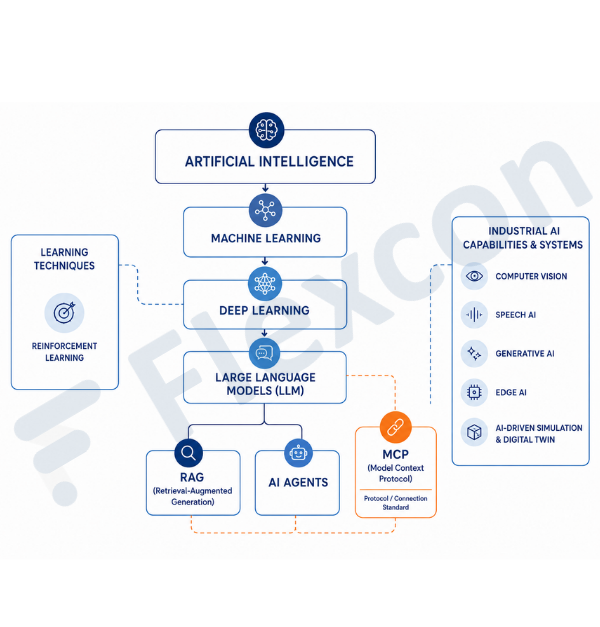
From an architectural perspective, the AI stack can be viewed as follows: how AI learns → which models it uses → how it is orchestrated → how it is integrated and deployed.
📖 Learning Approaches
Machine Learning → a set of techniques that enables systems to learn from data in order to make predictions, classifications, and decisions.
Deep Learning → a subset of Machine Learning based on deep neural networks, particularly effective in processing complex data such as images, text, and audio.
Reinforcement Learning → a learning technique in which an agent learns through interaction with an environment and by optimizing a reward function.
📖 AI Models
Foundation Models → large-scale models trained on vast amounts of data and subsequently adaptable to a wide range of tasks and domains.
Large Language Models (LLMs) → large neural models specialized in understanding and generating natural language and, increasingly, multimodal content.
Generative AI → a category of models capable of generating new content, including text, images, code, audio, and synthetic data.
📖 AI Architectures and Systems
Retrieval-Augmented Generation (RAG) → an architecture that combines generative models with information retrieval from external knowledge bases to produce contextualized and up-to-date responses.
AI Agents → systems that use AI models, memory, and external tools to plan and execute tasks in a partially or fully autonomous manner.
Multi-Agent Systems → architectures composed of multiple AI agents that collaborate or coordinate to solve complex problems.
📖 Integration and Deployment
Model Context Protocol (MCP) → an open protocol proposed by Anthropic to standardize the connection between AI models, tools, data, and external applications.
Tool Calling and API Integration → mechanisms that enable AI models and agents to use external software and services.
Edge AI → the execution of AI models directly on devices, machines, or local systems, reducing latency and dependence on cloud connectivity.
Cloud AI → the execution of AI models on centralized cloud infrastructures, providing high scalability and computational capacity.
Hybrid AI → architectures that combine local and cloud processing according to performance, security, and data availability requirements.
📖 MCP and MCP Servers
MCP (Model Context Protocol) is an open standard for connecting AI models to external systems and tools. It is often described as a “USB port for AI” because it simplifies integration with enterprise software and operational systems.
An MCP Server exposes data and capabilities to AI applications. It can provide access to databases, documentation, ERP and CRM systems, or specialized software. This enables AI Agents to retrieve information, perform searches, and invoke external tools in a controlled and secure manner.
From Conversational AI to AI Agents: What Changes?
The transition from conversational assistants to agentic systems redefines how AI can be integrated into business processes and operational activities:
- Response generation → Action execution
- Single interactions → Multi-step execution
- Natural language interfaces → Tool usage
- Limited context → Access to data and external systems
- Analysis and generation → Orchestration
- Conversational systems → Agentic systems
In industrial environments, these capabilities make AI Agents particularly suitable for applications involving Digital Twins, industrial simulation, and decision support.
From an operational perspective, therefore, conversational assistants are primarily designed to generate responses. Whereas AI Agents can interact with enterprise systems, orchestrate multi-step activities, and support decision-making processes within complex industrial environments.
Current and Emerging Applications of AI in Industry
In industrial environments, Artificial Intelligence is being progressively adopted across a broad range of application domains, each characterized by different levels of technological maturity and industrial deployment.
Its value increasingly derives from its integration with data sources, technical documentation, enterprise software, and operational technologies (OT). As a result, AI is creating new opportunities that range from process optimization to decision support.
| Application Domain | Objective | Examples of AI Applications |
|---|---|---|
| Production and Maintenance | Improve reliability and operational efficiency | Predictive maintenance, anomaly detection, remaining useful life (RUL) estimation |
| Quality and Inspection | Reduce defects and non-conformities | Computer Vision, automated inspection, and quality assurance |
| Planning and Scheduling | Support production planning and operational decision-making | Production sequencing, resource allocation, and scheduling optimization |
| Logistics, Supply Chain, and Intralogistics | Optimize material flows, capacities, and resource utilization | Demand forecasting, routing optimization, and warehouse management |
| Knowledge Management | Enable access to enterprise knowledge and technical expertise | Document retrieval, technical copilots, and operational support assistants |
| Industrial Simulation and Digital Twins | Model, analyse, and optimize complex systems through scenario evaluation | What-if analysis, scenario evaluation, virtual experimentation, process optimization, and decision support |
Industrial Simulation as a Natural Environment for AI
Unlike many other information systems, a simulation model already encapsulates:
- data;
- process logic;
- relationships between resources;
- operational rules;
- KPIs and performance metrics;
- alternative scenarios and operating conditions.
For this reason, industrial simulation represents one of the most promising environments for the evolution of advanced AI applications and agentic workflows.
Among these domains, 3D simulation and discrete-event simulation (DES) are particularly well suited, as they combine data, models, process logic, and decision-support capabilities within a single environment.
Software platforms such as FlexSim, Visual Components, AnyLogic, Plant Simulation, and other industrial simulation tools can be integrated with AI. This integration can dramatically reduce the time required for model analysis, scenario exploration, and the identification of optimal operating configurations. At the same time, it preserves the central role of engineering expertise and simulation specialists.
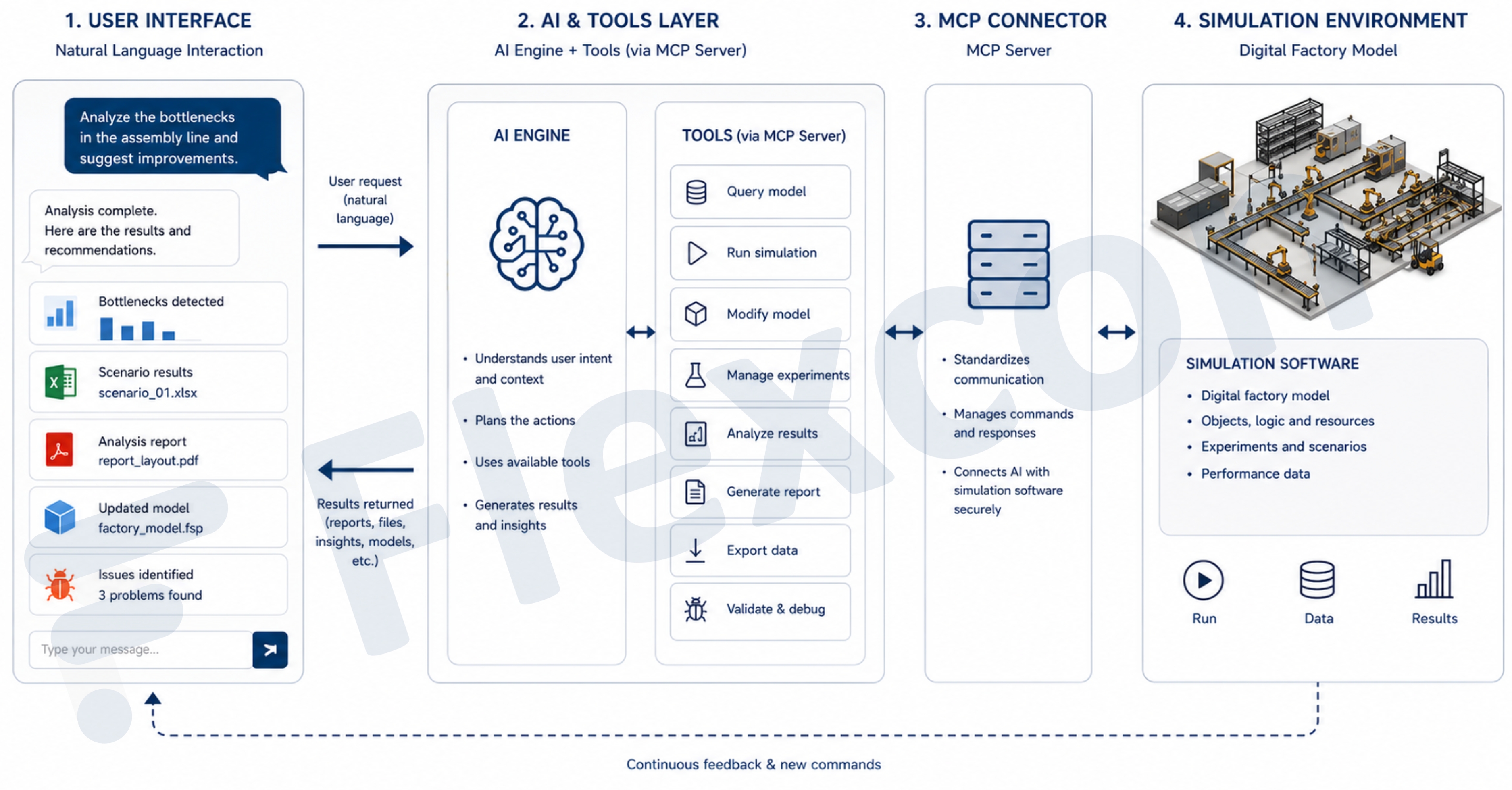
From Data Access to Intelligent Workflows
The evolution of AI is progressively shifting the focus from individual models toward ecosystems in which models, data, software tools, and operational systems work together. Value is therefore moving beyond the mere ability to generate content toward the ability to understand context, use tools, and support complex decision-making processes.
In this scenario, industrial simulation represents a particularly interesting environment, as it already integrates data, process logic, alternative scenarios, and performance metrics within a single model. For this reason, Digital Twins and simulation are becoming some of the most promising environments for experimenting with new AI architectures and agentic workflows.
This evolution, however, does not diminish the role of professionals who design, analyse, and use simulation models (see the article AI and Industrial Simulation: From Analysis to Decision-Making with Intelligent Digital Twins). On the contrary, it makes the ability to ask the right questions, interpret results, and understand the operational implications of decisions even more important. Competitive advantage will increasingly derive from the combination of AI, domain expertise, and integration capabilities.
Related readings
Model Context Protocol (MCP): Enabling Scalable AI Data Integration
AI and the Future of Industry
A strategic perspective on the opportunities, challenges, and industrial impact of Artificial Intelligence in manufacturing transformation.
(UNIDO and University of Cambridge)
Contact Flexcon to discover how simulation, Digital Twins, and Artificial Intelligence can transform your industrial processes.